
Electrohypersensitivity (EHS)
What is EHS?
Electrohypersensitivity is a recognized condition where individuals experience a wide range of adverse symptoms in response to man-made electromagnetic fields (EMFs) at levels far below established safety limits. Once dismissed, it is now gaining legal and medical recognition as a legitimate, disabling neuropathological disorder.
The condition is characterized by a diverse symptomatic profile, suggesting a multi-systemic biological dysregulation rather than a localized issue.
A Spectrum of Reported Symptoms
EHS presents a diverse range of complaints, with neurological and systemic symptoms being the most prominent.
The Science Behind the Sensitivity
Mounting evidence points to a clear biological cascade, moving EHS from a "medically unexplained" condition to one with identifiable pathophysiological mechanisms.
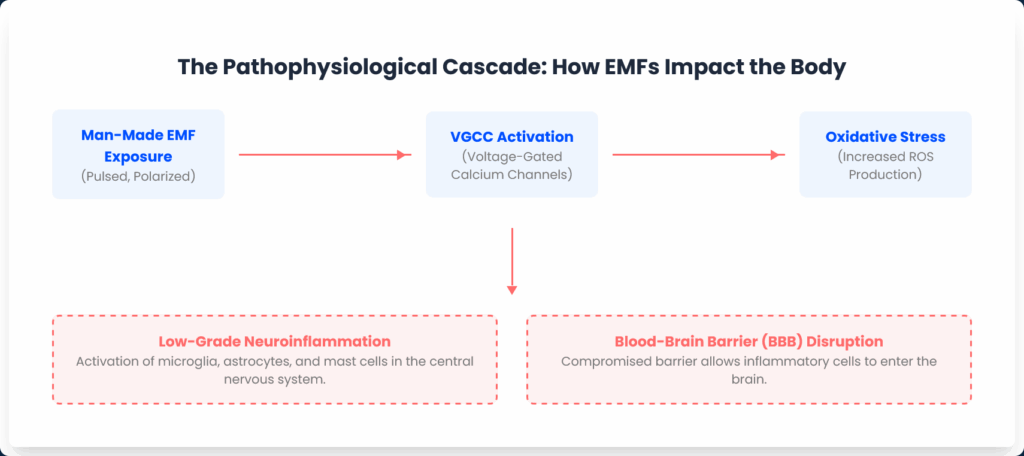
The Pathophysiological Cascade: How EMFs Impact the Body
Man-Made EMF Exposure
(Pulsed, Polarized)
VGCC Activation
(Voltage-Gated Calcium Channels)
Oxidative Stress
(Increased ROS Production)
Low-Grade Neuroinflammation
Activation of microglia, astrocytes, and mast cells in the central nervous system.
Blood-Brain Barrier (BBB) Disruption
Compromised barrier allows inflammatory cells to enter the brain.
🧬
Genetic Predisposition
Specific variations in detoxification pathway genes (e.g., GSTT1, GSTM1) can increase EHS risk by nearly 10-fold.
🩸
Inflammatory Markers
Elevated levels of Histamine (2-10x higher) and Heat Shock Proteins (HSP) indicate chronic, low-grade inflammation.
🧠
BBB Disruption Markers
Increased Protein S100B and Nitrotyrosine in the blood confirm a compromised blood-brain barrier.
🌙
Altered Melatonin
A notable decrease in the excretion of 6-hydroxymelatonin sulfate is found in ~90% of EHS cases, impacting sleep and antioxidant defense.
🛡️
Autoimmunity
Anti-myelin autoantibodies are detected in ~15% of cases, suggesting the immune system may attack nerve sheathings.
❤️
Heart Rate Variability
EMF exposure can alter HRV, indicating a physiological stress response and a disturbed circadian rhythm.
A Multi-Faceted Management Approach
Primary Strategy: EMF Exposure Reduction
The cornerstone of EHS management is avoidance. Reducing exposure to man-made EMFs is the most effective strategy for alleviating symptoms. This involves adopting "Safe Tech" practices.
- 📱Mobile Phones: Use speakerphone or air-tube headsets. Keep in airplane mode when not in use. Avoid carrying on the body.
- 💻Wired Connections: Replace Wi-Fi with wired Ethernet for internet. Disable wireless functions on routers and devices.
- 📞Corded Phones: Swap cordless landlines, which constantly emit radiation, for traditional corded models.
- 💡Smart Devices: Opt-out of wireless smart meters. Choose hardwired alternatives for smart TVs, printers, and other IoT devices.
- 🔌Sleep Hygiene: Unplug all electronics in the bedroom before sleep to create a low-EMF resting environment.
Efficacy of Nutritional Support
Patient surveys show dietary changes and supplements are perceived as highly effective complementary treatments.
Key Supplements:
- Melatonin: Potent antioxidant, combats EMF-induced oxidative stress.
- Glutamine: Supports intestinal barrier integrity and immune function.
- Antioxidants (C, E): Help protect cells from free radical damage.
- B Vitamins: Crucial for neurological function and energy metabolism.
How can we help you?

LiveSAFE
Nanorama Technologies Pvt Ltd
447/A, 9th Cross,
2nd Phase, JP Nagar,
Bangalore 560078, India
447/A, 9th Cross,
2nd Phase, JP Nagar,
Bangalore 560078, India
- +91 9916 911 911
- contact@livesafe.in

 contact@livesafe.in

